1. Your book Mozart's Music of Friends (official site: mozartsmusicoffriends.com) has proved once more that J.Haydn has played
a fundamental role in the evolution of chamber music, and has cast further
documentary
light on the strong connection between his chamber music works and the social conversational
interrelation typical
of the 18th century community and this from the very beginning. You mention in your book, just for example, his String Quartets
Op. 1 published
by La Chevardière in 1764 as Six Simphonies ou Quatuors Dialogués.
It's hard to overstate Joseph Haydn's importance, not only in terms of his own output
of chamber music but furthermore in terms of his influence on the following generation.
We all know the six quartets that Mozart dedicated to him, but I only recently learned
of the over 40 collections of quartets that were dedicated to Haydn during his lifetime.
My friend and colleague Balázs Mikusi, based at the National Széchényi Library in
Budapest, oversees Haydn's personal collection of quartets and has pointed out that
Haydn owned several of these published collections, which are mostly by composers
who today are little known. It's difficult to imagine a history of the Viennese
string quartet without Haydn, Beethoven, and Mozart.
2. Do you see a possible influence of the socio-political hierarchy system of the 18th
century Ancien Régime in the game of the parts and in the evolution of chamber music?
 I think about this in two ways, one literal and one more figurative. According to
an oft-cited foundation myth (reported by Haydn's biographer Griesinger), Haydn's
invented the string quartet at the request of a Baron Fürnberg, who needed music
for four friends to play together at his country estate. The story is probably not
true, but it reflects an understanding of the aristocracy's role as musical patrons
and hosts. It's hard to tell the story of Viennese chamber music in this period
without mentioning, for example, King Friedrich Wilhelm II of Prussia, Baron von
Swieten, or Prince Rasumovsky played vital roles (just to name a few). And certainly
the aristocracy's deep engagement in chamber music (especially in Vienna) influenced
those upper-middleclass families who sought to emulate their manners and customs.
If one's children could learn to play music with grace, that would elevate their
social status.
I think about this in two ways, one literal and one more figurative. According to
an oft-cited foundation myth (reported by Haydn's biographer Griesinger), Haydn's
invented the string quartet at the request of a Baron Fürnberg, who needed music
for four friends to play together at his country estate. The story is probably not
true, but it reflects an understanding of the aristocracy's role as musical patrons
and hosts. It's hard to tell the story of Viennese chamber music in this period
without mentioning, for example, King Friedrich Wilhelm II of Prussia, Baron von
Swieten, or Prince Rasumovsky played vital roles (just to name a few). And certainly
the aristocracy's deep engagement in chamber music (especially in Vienna) influenced
those upper-middleclass families who sought to emulate their manners and customs.
If one's children could learn to play music with grace, that would elevate their
social status.
But a second way to answer this question is more metaphorical: the Enlightenment
period brought about changing attitudes in music (just as in society) toward hierarchy
vs. equality. If an earlier styles had more prescribed roles for melody instruments
vs. harmony instruments vs. the bass, late-18th-century chamber music draws
special attention to the role-exchange and witty interplay among the parts. The
theorist Heinrich Christoph Koch writes that, in a string instrument, there is not
a single instrument with the ancestral privilege (Vorrecht) to be the main melody,
but four main melody instruments that exchange taking leading roles. This spirit
of interchange seems to me to emulate the witty repartée of the salons, which cultivated
a certain loosening of strict, aristocratic hierarchy.

3. After having delineated the fundamental aspects of the real meaning of conversation
in music in the 18th century and then having reached
the formal definition of a
Multiple Agency methodology, what is your technical
advice to the musicians who want to play chamber music in a more
historically informed way?
Of course there are many ways a performance can be informed (by history, by our
own intuitions, by inspiration from other art forms, by innovative new ideas, etc.),
and that's very a good thing.
As far as historically informed performance, we're all familiar with sources about
period instruments, ornamentation, etc. But another way to be historically informed
is to consider the spirit of the music vis a vis the culture that gave rise to it.
This is what led me to exploring the Enlightenment salons, which emphasized sociability,
wit, and artful conversation. This is mirrored in the music that was played in these
salons, you can see this in both historical accounts of these performance settings
and in paintings or drawings that depict them, since the social aspects are emphasized
as much as the musical ones. Therefore, sensitivity to this spirit of social intercourse
is another way to be historically informed that matters just as much as, say, playing
on gut strings or with a fortepiano.

4. Do you think there may be possible technical solutions to perform chamber music on
stage, but reproducing at the same time the more intimate and private salon atmosphere
for which most of chamber music was originally conceived?
At John Ella's Musical Union concerts in England (founded 1845), he placed the
musicians in the center with the audience seated all around them. He wrote that
this was meant to simulate for a larger audience the intimate experience of a Quartettabend
in a Viennese salon.
Whether it's the setting of the room, or the way musicians interact with audiences,
I think we can find ways to emulate aspects of the private salon atmosphere for
larger audiences. The strict rituals and protocols of the traditional concert hall
are not for every listener, so there's room for us to experiment with ways to break
down the wall from performers to audience. Usually we think that to do so is very
innovative, but perhaps it's actually going back to traditions that predate the
formal concert halls.
5. Your favourite work by Mozart and your favourite work by J. Haydn.
I'm glad I don't have to limit myself to playing just one! But since you ask for
one of each, I'll mention the Mozart Kegelstatt Trio, which is a favourite of mine
being a violist. The story that Mozart composed the game while playing skittles
(Kegelspiel) is not true, although Mozart was a great enthusiast of the game.
But since the piece was written for the theretofore unprecedented combination of
piano, clarinet, and viola, Mozart is constantly inventing new ways to use the instruments
within the texture, and the players seem to be working out their roles throughout
the piece as they do. Of course the piece is of special interest for me, being a
violist, since Mozart wrote that part to play for himself.
And for Haydn, I'd mention the Trio no. 44 in E Major, which (as I violist) I unfortunately
can't play. But the opening is brilliant, since it's as if the piano wanted to play
pizzicato - a piano masquerading as a string instrument!
6. Do you have in mind the name of some neglected composer of the 18th century you'd like to see re-evaluated?
Reading Mozart's letters, I'm struck that he very often writes, «I arrived at the
home of so and so, in such and such a city, and he had some very pretty new keyboard
sonatas by composer XYZ». More often than not, XYZ is a name that I haven't heard
of and who is no longer part of the concert repertoire, and yet Mozart thought their
sonatas were worth playing through and thinking about. Leaving aside the question
of whose sonatas are better - not the most interesting question - we could at
least say that music by so-called Kleinmeister helps us to understand the world
Mozart or other more familiar composers operated in and the conventions they were
drawing from. Music scholars are starting to look more thoughtfully at the broader
landscape, rather than study a handful of master composers in a vacuum. See, for
example, Robert Gjerdingen's book Music in the Galant Style.
7. Name a neglected piece of music of the 18th century you'd like to see
performed in concert with more frequency, especially after the long
documentary research you
have carried on for your book Mozart's Music of Friends.
I'm a big fan of Mozart's piano-and-violin sonatas and violin/viola duos, which
I wish I'd hear more often in concerts and in recordings.
As for lesser-known composers: I can't name one piece, but as a musician interested
in string quartets, I am struck how few composers are represented in concerts today
and how few I really know (especially since so many quartets were published only
in parts and have never appeared in scores).
The Viennese music publisher Johann Traeg published an advertisement in 1784 in the Wiener Zeitung
offering essentially a Netflix-like service for chamber music parts.
For a modest fee, he would provide music for your weekly, private
chamber music gatherings at your home (either three symphonies or six
quartets, quintets, or sextets), but he required that the parts be
returned the following day so you could receive new pieces the following
week. His rental catalog contained over 1100 quartets, in more than 200 collections, by over 100 composers!
(How many quartet composers from this period can you name?) This gives a
sense for the voracious appetite of the Viennese aristocracy for new
quartets to play through, week after week. Probably many of them were
written more to sight-read through for fun, rather than to live with
over a lifetime (as we do with canonical works today), but it gives an
idea how much repertoire is out there than remains obscure today.

8. Beside your books, do you have in mind a particular book on Mozart Era you consider
important for the comprehension of the music of this period?
It's hard to name just one! For a global view of the period, I can recommend very
highly Daniel Heartz's magisterial and amply documented trilogy of books, (1) Music
in European Capitals: The Galant Style, 1720-1780, (2) Haydn, Mozart, and the
Viennese School: 1740-1780, and (3) Haydn, Mozart, and Early Beethoven: 1781-1802.
He has other books too, including a great study of Mozart's operas. His protegé
John A. Rice has a book called Music in the Eighteenth Century that covers much
of the same ground but more concisely in a single volume.
I would also mention the outstanding new collection entitled the Oxford Handbook
of Topic Theory, edited by Danuta Mirka. The over twenty contributors explore musical
topics or styles, such as the hunting style, brilliant style, ombra style, or
dance styles, which gets into expressive musical meanings that we recognize when
we play or listen to this music. The idea of musical topics was first suggested
in a lovely book by Leonard Ratner entitled Classic Music, which has been a strong
influence on my own work. Ratner's influence cannot be overstated, since students
and disciples, such as Wye Allanbrook, Kofi Agawu, and Raymond Monelle, have written
important books that explore these same aspects. For example, Allanbrook points
out that Figaro's aria Se vuol ballare is essentially a stylized minuet. If a
listener recognizes that the servant is singing in the style of a courtly, aristocratic
dance, then it takes on extra meaning when he says Se vuol ballare, signor contino,
il chitarrino le suonerò (If you wish to dance, my little count, I'll play the
little guitar).
Then I'd be remiss if I neglected to mention Charles Rosen's The Classical Style,
which is such an important landmark in 18th century studies. My own book is dedicated
in his memory, and his way of hearing the witty interplay of opera buffa in string
quartets was profoundly influential for my work.
9. Name a movie or a documentary that can improve the comprehension of the music of
this period.
Scholars are quick to point out the historical problems with Amadeus (Milos Forman's
adaptation of Peter Shaffer's play), which is indeed highly fictionalized. But there
are certain scenes in it that ring true to me in some way, and besides, the acting
is superb. There's a scene toward the end that shows Mozart composing parts of Die
Zauberflöte in a pub, among his musician friends who try out the music as quickly
as he composed it. The scene is pure fantasy, but it captures the silly tone Mozart
uses in his letters and that surely were a part of his collaboration with Emanuel
Schikaneder, the impresario who produced the performance, wrote the libretto, and
performed at Papageno. One could imagine Pa-pa-pa-pa-pa-pageno growing out of
just such an evening of revelry!
10. Name a place to be visited that proved crucial to the evolution of the 18th century
music, considering that then also some composers friends of Mozart, like Pleyel
and Vanhal, rapidly reached the New World with their music and even with own Societies
of Followers and considering the special relation
between the von Zinzendorf family and the Viennese salons and Mozart himself.
As an American, I always enjoy visiting Europe because I am surrounded by so many
famous places in the history of western concert music. When I first visited Vienna
and searched for my grandmother's childhood home, I found that it was just around
the corner from Haydn's house.
But in the United States we have some sites with interesting 18th-century
musical history as well. I recently attended a conference at Moravian College in
Bethlehem, Pennsylvania. The Moravian community in Bethlehem was founded in 1741
by Nikolaus
von Zinzendorf,
and music was fundamental to their society. For instance, the basic social unit
in their community was called the choir. One of the scholars who organized the conference,
Sarah Eyerly is also a descendant of the community and organized an authentic Singstunde
service and performance of Moravian songs accompanied by cittern and harp. Our venue
at Moravian College was originally known at the Brethren's House, built in 1748
and later visited by George Washington.
And exactly there in 1811 the American premiere of Haydn's The Creation was organized
in the Sanctuary of Central Moravian Church. So I think it's a strong symbol of
how the Viennese divine sparkle of the music of friends of the circle of Mozart
and Haydn managed to reach and enlighten so many parts of the World in just few years! Thank you very
much for having taken the time to answer our questions!
Thank you!
Copyright © 2016 MozartCircle. All rights reserved.MozartCircle exclusive property.
Iconography from the site mozartsmusicoffriends.com or from the book is in public domain or in fair use.


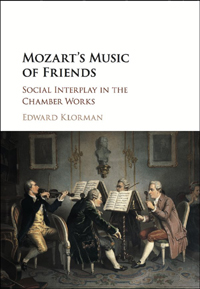

 Following the path created by the author, the
reader will discover an entire secret world, that very exclusive environment which
gave birth to much admired masterpieces of all times, a world where musical-rhetorical
concepts of equivalence govern the internal voices jotted down on score sheets by
that Haydn, who seems to attentively ponder the precepts of the Ars Poetica by Horace
before even choosing the number of instruments to be used in one of his works, a
world where sociability, tensions and relational amicability among friends and performers
change the conversational course of a trio or of a quartet by Mozart, where 18th
century and 19th century forms of analytical formal treatment of music, even profoundly
imbibed of Ciceronian rhetorical rules and distinctions (as Jones, 1784: the Talk
of the Teatable vs. the Oratory of the Bar and the Pulpit), suggest how a voice
in a quartet must speak and what is its role in the hierarchy, and if a hierarchy
does really exist among the four voices of a quartet. In this way, Klorman leads
the reader through the analysis not only of the 18th century rituals of the light-hearted
conversational game of the Musik spielen among friends and of the Hausmusik, all
social activities under the rule of an omnipresent sight-reading absolute imperative,
but also of the main 18th century theories and formal descriptions of the conversation
in music, and even in reference to its actual practice, from Sulzer, Koch, Carpani,
Momigny up to the most querulous pseudo-Cambini and the enlightening poems by a
Talleyrandian funambulist like Baillot, an avid promoter and performer of the Viennese
quartet, who can really walk the tightrope of his times and conceive, after so many
Napoleonic imperial wars and so many political and military upheavals, a violin
who is the king (!) of a republic.
Following the path created by the author, the
reader will discover an entire secret world, that very exclusive environment which
gave birth to much admired masterpieces of all times, a world where musical-rhetorical
concepts of equivalence govern the internal voices jotted down on score sheets by
that Haydn, who seems to attentively ponder the precepts of the Ars Poetica by Horace
before even choosing the number of instruments to be used in one of his works, a
world where sociability, tensions and relational amicability among friends and performers
change the conversational course of a trio or of a quartet by Mozart, where 18th
century and 19th century forms of analytical formal treatment of music, even profoundly
imbibed of Ciceronian rhetorical rules and distinctions (as Jones, 1784: the Talk
of the Teatable vs. the Oratory of the Bar and the Pulpit), suggest how a voice
in a quartet must speak and what is its role in the hierarchy, and if a hierarchy
does really exist among the four voices of a quartet. In this way, Klorman leads
the reader through the analysis not only of the 18th century rituals of the light-hearted
conversational game of the Musik spielen among friends and of the Hausmusik, all
social activities under the rule of an omnipresent sight-reading absolute imperative,
but also of the main 18th century theories and formal descriptions of the conversation
in music, and even in reference to its actual practice, from Sulzer, Koch, Carpani,
Momigny up to the most querulous pseudo-Cambini and the enlightening poems by a
Talleyrandian funambulist like Baillot, an avid promoter and performer of the Viennese
quartet, who can really walk the tightrope of his times and conceive, after so many
Napoleonic imperial wars and so many political and military upheavals, a violin
who is the king (!) of a republic. This second part of the book is so magnificently
completed by a fundamental series of theoretical practical applications of the Multiple
Agency methodology seen at work in combination with the Sonata Form and the Models
of the Metrical Musical Analysis and we can assist, in this way, at important formal
treatments of Mozart's chamber works, which lead the readers to a more profound
comprehension of their music: K. 304, K. 493, K. 465, K. 379 and, above all, K.
498 the Kegelstatt trio, one of the summits of the Mozartian production of his music
of friends, where an extravagant and totally unusual trio (piano, clarinet and viola)
is a musical personification, thus conceived by Mozart himself from the very beginning,
of that special conversational interrelation among the three close friends: Franziska
von Jacquin, Anton Stadler and W.A.Mozart.
This second part of the book is so magnificently
completed by a fundamental series of theoretical practical applications of the Multiple
Agency methodology seen at work in combination with the Sonata Form and the Models
of the Metrical Musical Analysis and we can assist, in this way, at important formal
treatments of Mozart's chamber works, which lead the readers to a more profound
comprehension of their music: K. 304, K. 493, K. 465, K. 379 and, above all, K.
498 the Kegelstatt trio, one of the summits of the Mozartian production of his music
of friends, where an extravagant and totally unusual trio (piano, clarinet and viola)
is a musical personification, thus conceived by Mozart himself from the very beginning,
of that special conversational interrelation among the three close friends: Franziska
von Jacquin, Anton Stadler and W.A.Mozart.


